Inside Llewyn Davis

“Inside Llewyn Davis” is the Coen Brothers’ searingly intimate folk ballad.

Folk music is that most honest of all music genres. It’s often just a man, his words and his guitar, and through simple song structure and intimacy of the performance, it hits searing individual truths. And yet when folk music is done poorly, it can be the most hammy and phony of all, a parody of itself and hardly a solid piece of music.

The only American directors capable of handling that dichotomy are the Coen Brothers. The two are masters of characterization and tone, bordering on satire and sincerity with each of their characters. “Inside Llewyn Davis” is their folk ballad, and it’s a searing portrait of an unlikeable and sullen artist, one that feels warm and honest without ever trying to fake folksy charm.

“Inside Llewyn Davis” could not be possible without the lead performance of its title character by Oscar Isaac. In this film full of cartoonish supporting players coloring a strange, tough-to-crack world, Isaac plays Llewyn with every ounce of attitude and truth. Llewyn is completely unlikeable, stuck-up, lazy, pretentious, snarky and never cool, and Isaac turns him into a tragic figure befitting a travelling folk song. Continue reading “Inside Llewyn Davis”

The Book Thief

“The Book Thief”, based on Markus Zusak’s novel, is both tragic and whimsical to a fault.

The Book Thief Movie

There’s no rule that Nazi Germany be depicted only as gray with splashes of red swastika flags, but to see it prettied up in snow white colors for much of Brian Percival’s “The Book Thief” makes the contrasting themes a bit off-putting.

Although it gets a pass on the light-hearted and nuanced performances of its lead actors, “The Book Thief” forms an unholy marriage between historical melodrama and a childlike fable. It feels overly precious, and it becomes both tragic and whimsical to a fault.

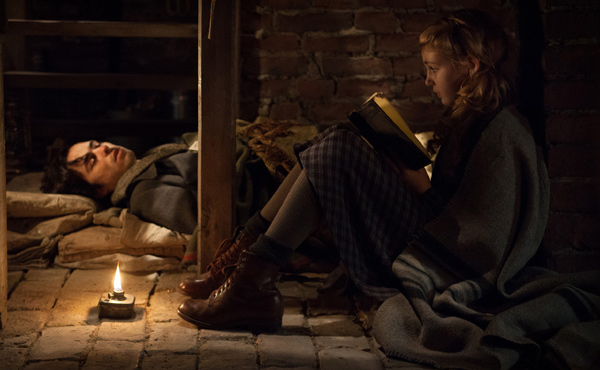
Percival’s film is based on Markus Zusak’s novel of the same name, and it follows a little girl named Liesel (Sophie Nelisse of “Monsieur Lazhar”) as she’s being dropped off with a new German family. Her mother is a Communist on the run and her younger brother has just passed away from illness, and now Liesel is alone with her new father and mother, Hans and Rosa (Geoffrey Rush and Emily Watson).

Liesel cannot read and slowly begins to learn with her father, but when Hans takes in a sickly Jew on the run named Max (Ben Schnetzer), Liesel befriends him and helps nurse him back to health by reading him banned and stolen books. Continue reading “The Book Thief”

Stories We Tell

Sarah Polley’s touching and slightly experimental documentary about her family.

“Stories We Tell” is a groundbreaking documentary tackling the most familiar of subjects: your own family. It’s Director Sarah Polley’s (“Away From Her,” “Take This Waltz”) own account of her family’s life story along with the accounts from each of her family members, but she weaves a story that feels universal. What’s daring and so intellectual about it is hidden deep into the film after it has wrapped you in its warm family embrace.

“Who the fuck cares about our stupid family,” asks one of Polley’s sisters as she sits down in front of the camera. Polley tells the story, “the whole story, in your own words,” of her mother Diane from the perspective of everyone living who was directly involved in her life. And while we quickly get to know Diane as a charming, life-of-the-party type woman from the memories of her family and friends and from archive, home movie footage, Polley is smart to make us think about her sister’s question.

What the whole family realizes after some time however is that no one perspective is the “truth,” and when Polley picks and chooses the details that don’t conflict, the ones that tell a good story and show the Diane that she wants to remember, the narrative she edits together is less a reflection of any truth we’d like it to be.

If this sounds like profound homework, it’s not. Polley devotes time to her father Michael to narrate a long autobiography of his life with Diane. Together with the family on camera, they talk of falling in love, sex, the highs and lows of home life, personal secrets and the dark, often sad state of their marriage. Diane died of cancer when Polley, the youngest of all the family’s siblings by over a decade, was just a child.

Over time however, Polley uncovered a strange story that for years was just a running joke in her family. Ever since Sarah was born, there were murmurs that Diane had an affair when she went off and acted in a play in Montreal. At times there was question of whether an abortion was in order, or if she might have another father due to her red hair, but as Diane got ill, any rumors were just water under the bridge. Continue reading “Stories We Tell”

The Hunger Games: Catching Fire

“The Hunger Games: Catching Fire” finds new director Francis Lawrence raising the stakes on this already dark franchise.

“The Hunger Games” franchise has now done what it took the Harry Potter movies perhaps four or five films to get right. “Catching Fire” is a sequel that sees its stakes increase tenfold, its action becoming more crisp and polished, its themes growing deeper and its deep cast of talented individuals gelling completely.

It does beg the question, how does a story in which teenagers murder other teens for sport and sacrifice manage to get darker, more serious and more consequential? Gary Ross’s “Hunger Games” was a film about the internal struggle of an individual to find her strength and voice. It treated survival instincts like a virtue. Now in “Catching Fire,” that lone wolf mentality to just survive plays like another death sentence.

New director Francis Lawrence ties “Catching Fire’s” dystopian future concept and steamy love triangle to broader ideas about rebellion, fame, loyalty and psychology. Best of all, he’s packaged it in a slick, suspenseful package that hasn’t lost any of its twisted edge.

“Catching Fire” resumes shortly after Katniss and Peeta’s (Jennifer Lawrence and Josh Hutcherson) victory from the previous games. Now President Snow (Donald Sutherland) is using their celebrity as a symbol of false hope as he tours them around each district of Panem. Snow threatens to kill Katniss and her family unless she tows the evil Capitol’s line and makes her act in front of the cameras genuine.

Katniss however has become a reluctant symbol of a slowly growing rebel uprising. The film has done a wonderful job playing up the franchise’s iconography, with early shots framing Katniss as a figure of solemn power or people raising three fingers in defiance to the Capitol and making it feel significant. When they do celebrate her legend, people are beaten and killed by the Capitol’s “peacemakers,” faceless stormtroopers modeled off another similar franchise, “Star Wars.”

Because she’s creating problems, the new Master of the Games, Plutarch Heavensbee (Philip Seymour Hoffman), arranges a special event for the 75th Annual Hunger Games in which past survivors of the games are forced to compete again. Given how few there are still living, Katniss and Peeta are on the chopping block yet again. Continue reading “The Hunger Games: Catching Fire”

Blackfish

“Blackfish” is a scathing investigative documentary about Tilikum the killer whale and SeaWorld.

The 2010 documentary “The Cove” gave me all the reason I needed to never return to SeaWorld again. While that film played like a melodrama, horror movie, heist caper and took swipes at an entire country and their “culture”, the new documentary “Blackfish” targets the amusement corporation directly with a scathing journalistic exposé.

Gabriela Cowperthwaite’s film is produced and distributed by CNN Films, and it has a sharp investigative quality and traditional, talking heads approach to this horror story. While it lacks some of “The Cove’s” pathos and energy, it still packs a wallop.

“Blackfish,” like “The Cove,” has the unique quality of not being an environmental film. Both dolphins and whales are characterized as animals with specifically human-like qualities. Each of the trainers that interact with the orcas describes the sensation of looking into their eyes and seeing something back. Cowperthwaite can reach the audience on moral terms and never has to raise questions of the effect of removing these whales from their habitat on the broader environment.

It’s more accurately the story of Tilikum, a male killer whale captured from the wild in the ‘70s since used to breed others throughout the SeaWorld enterprise. In 1983, he killed a female trainer at a dinky amusement part called Sealand. The “accident” was swept under the rug and Tilikum was sold to SeaWorld, where 20 years later he killed Dawn Brancheau in much the same manner. Continue reading “Blackfish”

Dallas Buyers Club

Matthew McConaughey’s performances as Ron Woodroof marries the gristle and charm found in “Dallas Buyers Club.”

Dallas Buyers Club

Throughout Matthew McConaughey’s career, he’s exerted a certain level of charisma and charm in every role he’s played. Even in this reinvented hot streak of his career where he’s played sleazy, scary and strange characters who could not be more off type from his rom-com roots, there’s a certain mark of personality that has allowed him to settle into yet another comfort zone.

His performance in “Dallas Buyers Club” is different, one that drains him of any likability and finds him at this lowest point. Doing purely lived-in and physical work, McConaughey shows his abrasive, lewd, intense and vulgar dark side before winning us over again. This may not be the showiest performance of his recent run of movies, but it’s the one that demonstrates the most range, the most compassion and the most chance at winning him an Oscar.

“Dallas Buyers Club” is the true story of Ron Woodroof, a slimy electrician and rodeo jockey in Texas in the 1980s. Despite his lanky appearance (McConaughey lost nearly 40 pounds for the role), greasy hair and scummy potty mouth, he still finds himself having sex with women and “$100 hookers” in his trailer home and in dark corners of the rodeo arena.

After being brought to the hospital due to an accident at his job, the doctors inform him that he has tested positive for HIV, that it has already become AIDS and that he has roughly 30 days to live. Woodroof is staunchly heterosexual and shockingly bigoted and refuses to believe he has a disease like “that Rock Cocksucker Hudson” until he does his own research and pleads for help from Dallas Mercy’s Dr. Eve Saks (Jennifer Garner).

She gives Woodruff two options: a support group where he can “go get a hug from a bunch of faggots” or a double blind test of a drug called AZT, in which some patients will only receive “sugar pills,” better known as placebos. Continue reading “Dallas Buyers Club”

CIFF Review: Domestic

“Domestic” is a comedy as part of the Romanian New Wave, and it captures family dynamics with a surreal twist.

“Domestic” screened as part of the Chicago International Film Festival, where it had its American debut. This early review is merely an impression from the festival. It does not have an American release date. 

Our extended family is Italian. Being loud, persistent talkers is just part of the dynamic. That anything funny or even profound can come out of the conversation at all is a triumph.

Although the families in “Domestic” are Romanian, director Adrian Sitaru has some absurd fun with this conceit: keep the chatter up as normal and see what surprises can come out of it.

“Domestic” is a household comedy following in the footsteps of several families and tenants in a single apartment building. The whole building is up in arms over a timid dog that has supposedly caused some problems. The landlord argues and discusses it with his wife and pre-teen girl one evening. It’s a conversation as normal, but Mom has just brought home a live hen for dinner. Mom assumes Dad will kill it, Dad doesn’t know why Mom bought it and the girl volunteers to take care of it… for a small fee.

Where did she learn how to do that? “That’s how kids in America make their money.” The scene seems to continue on in a loud, speedy argument for quite some time until finally there’s blood on the wall. We hear screeches from the bathroom down the hall, and the door swings open with the little girl humming and smiling as though this was a normal occurrence. On paper this seems grim if not downright surreal. But with a richly cultured audience who understands this family dynamic, it’s hilarious. Continue reading “CIFF Review: Domestic”

CIFF Review: Closed Curtain

Jafar Panahi is still under house arrest, “Closed Curtain” IS a film, and it’s a puzzling mess.

“Closed Curtain” screened as part of the Chicago International Film Festival, where it had its American debut. This early review is just an impression from the festival. The film does not yet have an American release date.

“Closed Curtain” starts with a stark reminder that its director, the Iranian Jafar Panahi, is still under house arrest by the Iranian government and banned from making films. His first under these conditions was the critically acclaimed “This is Not a Film.” This is a film however, and it’s a strange hybrid of fantasy and documentary that, with the strenuous nature of its making, collapses under the weight of being so meta.

The opening shot is an extended take of the camera facing out a barred window. It sits there as though it’s just recording whatever may pass by, and over agonizing minutes, we see a man pull up in a car, take a bag out and carry it all the way inside the house. He has just smuggled a dog into the home, but the man is not Jafar Panahi.

He’s a writer (Kambuzia Partovi), and he’s illegally harboring this dog in his home, covering up the windows with black curtains to hide that he has it. But one night as he is cleaning out the dog’s litter box, two refugees find his way into his home. One goes to look for help while the other, a young woman named Melika (Maryam Moqadam), remains and causes the writer unnecessary stress. Continue reading “CIFF Review: Closed Curtain”

CIFF Review: Salvo

“Salvo” is a peculiarly modest Italian thriller with a minimalist story and style.

“Salvo” screened as a part of the Chicago International Film Festival. This early review is merely an impression of the version screened. It does not yet have an American release.

Would you recognize a miracle when you saw one? We view miracles on a grand scale, and they probably happen every day without many people noticing. It’s not quite what they mean when they say “miracles come in small packages,” but the mini-miracle of “Salvo” is that it strips away virtually all of its story telling or character embellishments and discovers something special through senses alone.

“Salvo” is an Italian mob film that premiered this year at Cannes. It’s immediately a misleading label, as the film is without action or any sort of mafia family plot structure for its entirety.

After being ambushed and almost killed, a nameless assassin (Saleh Bakri) discovers who arranged his murder and hides out in his home to kill him.

Awaiting him is a blind girl named Rita (Sara Serraiocco). She never leaves the home and spends time listening to pop songs and counting money. Agonizing minutes go by as the assassin sneaks out of Rita’s way, the camera playing close to the chest and the back of the head to create palpable trepidation and tension. But just as he’s killed Rita’s companion and held her, blinding light suddenly comes from her perspective, and for the first time we get a glimpse of our mobster’s face.

She can see, although not clearly yet. “Salvo” plays with the idea that someone being given sight for the first time in their life may take significant time to adjust to massive amounts of light their eyes have never known.

The assassin locks her in an abandoned warehouse as she gains her eyesight back, and the resulting film is essentially a love story between two people in need, one of them trying to escape the world they’re in, the other being forced to discover it.

“Salvo” in a way reminds of “Only God Forgives,” a slight tale of redemption told through style and sensory imagery alone. Both films are expertly made, but directors Fabio Grassadonia and Antonio Piazza have a fascinating way of depicting sounds and sights through pure minimalism rather than Nicolas Winding Refn’s opulence.

“Salvo” is sinister and arresting when it wants to be, but it’s awfully thin as a result. What little there is to latch on to in terms of character and ideology is something the intimate, tense and measured aesthetic can’t make up for.

3 stars
Nebraska

Alexander Payne’s latest film stands to be a hilarious crowd pleaser.

“Nebraska,” Alexander Payne’s black and white road trip comedy of middle America, has a habit of demeaning and humiliating the simpleton white folks who fill out the ranks of this country. Their mouths are slightly agape, they’re overweight, they lack ambition or much to say as they sit uniform in front of a small television with their cheap beer, and the marquees and sign posts in town feel modest and bland with words like “Sodbuster” and “Bankman” serving as the Midwestern town’s only landmarks.

It’d be easy to say that Payne’s movie feels slight and that these people are too easy of targets, but America as a country is a bit humiliating. That doesn’t mean that the film and the people can’t harbor a sense of kindness and pride that gives this country its character.

“Nebraska” is great Americana. It’s a warm, funny, wholesome film that captures the comical family dynamics of ordinary people. Perhaps this isn’t your family, but we seem to know families like this, and it can be a beautiful sight to see. Continue reading “Nebraska”