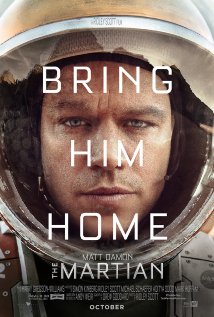
The Martian

Matt Damon stars in Ridley Scott’s adaptation of Andy Weir’s sci-fi novel ‘The Martian’

TheMartianPosterThe most impossible feat in Ridley Scott’s “The Martian” is not that a man can survive on Mars. “The Martian” is refreshingly optimistic, a movie that believes in not just the ingenuity and resourcefulness of mankind but the camaraderie and good-nature. It speaks to the power of the Internet and society in the 21st Century to collectively find a solution, but also rally around a moment in history. At the end of “The Martian” the whole world is watching in a unified sensation to see if Mark Watney will make it back alive. That’s an inspiring fantasy we only see in the movies, and one even less common in 2015.

Who better to incite humanity’s collective attention and care than an everyman movie star like Matt Damon? Damon here embodies pure American values and a can-do attitude, even as he sheepishly blows himself up or loses his cool. He’s a guy, above all, the kind of guy you’d want to be stuck alone on a planet with, but he’s a movie star and he’s better than you, so he’s exactly the person we want to root for.

Damon is Mark Watney, a member of a mission to Mars that goes wrong when a violent storm strands Mark from his team, who leave him for dead on the red planet. When he wakes, he quickly realizes his survival hinges on lasting long enough for another manned mission to arrive, potentially as long as four years, on communicating with NASA to let them know he’s still alive, and to grow food on a planet where nothing grows.

Good news! “I’m a botanist,” he proclaims, as if to say, “Challenge accepted. Bring it, Mars.” Mark gins up a way to grow potatoes for as long as four years, he finds a way to create water (just take two parts hydrogen and add oxygen. Not that anything bad has ever happened with humans trying to manipulate hydrogen), and he harvests leftover plutonium and a rover from previous Mars missions.

Back on Earth, NASA’s scientists have to be worn down over time to reject their cynicism. They’re all calculations and risk, dismissing Mark’s initially rudimentary attempts to communicate. Soon they’ll come around, and so do we. There’s not a moment in “The Martian” where we don’t believe in Mark’s gumption to survive or his creativity in McGyvering a solution, even something as simple as “Duct tape fixes everything.”

Part of that is “The Martian’s” embrace of science and logic. “The Martian” is methodical and practical in its explanation as to how Mark will survive, and the film never harbors an illusion that it’s about anything else but the ability to tackle the impossible.

But another part is that the film is perhaps quieter and more contemplative than the edge-of-your-seat thrill ride that was “Gravity”, another lost-in-space film with impossible odds. Mark communicates via video logs, so “The Martian” isn’t quite as reserved as something like “All is Lost”, but it sets aside time for Mark to enjoy some bad disco music or to bemoan running out of ketchup.

“Gravity” never had time for such scenes in its slick 90 minutes, and while that film found incredible economy by never setting back down on Earth, “The Martian’s” Earthbound scenes don’t feel like an after thought. Scott paces the film in dual, cross-cutting action, with NASA and JPL engineering the same solutions for communication or for outfitting a rover as Mark is figuring things out. Chiwetel Ejiofor and Jeff Daniels make sparks as NASA’s two directors debating how best to allocate resources to rescue Mark. And following “Magic Mike XXL”, this is the second film this year in which Donald Glover shows up halfway through and stops the show with his captivating performance.

When Sandra Bullock touched down on Earth, she was all alone on an idyllic lake. “The Martian” visualizes a breathtaking and inspiring homecoming in Times Square, with the whole world hooked on Mark’s safe return. Such a sight seems as unlikely today as a man trapped on another planet. But “The Martian” earns those lofty aspirations and positive, inspirational sensations because it believed in them to begin with.

4 stars
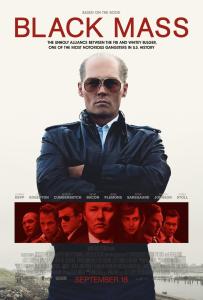
Black Mass

Scott Cooper’s follow-up to ‘Out of the Furnace’ stars Johnny Depp as Boston gangster James ‘Whitey’ Bulger

BlackMassPosterThe best scene in “Black Mass”, a biopic on the life of Boston’s notorious gangster James “Whitey” Bulger, is when a naïve, young waif of a girl is picked up by Bulger and her stepdad after spending the night in jail. Bulger grills her on exactly what the police asked of her and how much she knows. What’s exciting about the scene is not the fear of what Bulger might do but how oblivious she is to all the danger she’s in.
The amusing nature of this exchange may be entirely unintentional. We know exactly what Bulger’s going to do with her. Director Scott Cooper has reduced Bulger into a monster, not even a ruthless human being with a hint of dimension. He kills and has people kill for him, and his fuse is so short that any sense of his humanity, or of those around him, is long gone.

Appropriately, Johnny Depp plays Bulger with an alien sensibility in line with his equally eccentric performances for Tim Burton and others. Thin, slick-backed gray hair, a forehead that dwarfs even his massively dark old-man sunglasses, and piercing blue eyes make him more vampire than gangster.

But Depp’s performance feels hollow in a movie that has little substance or real style behind it. “Black Mass” documents Bulger’s rise to power in the South Side of Boston during the ‘70s and ‘80s when Bulger became an informant for the FBI and his old childhood buddy John Connolly (Joel Edgerton). Connolly believes by looking the other way on Bulger, his intelligence can help the agency land a more significant Italian mafia family. But once the mob is out of power and Bulger is given a free reign of terror, the movie loses its steam. Cooper bookends the film with interview testimonials of Bulger’s crew making confessions, so there’s no tension to if or when Bulger and Connolly’s jig will be up.

Cooper has some talent as a director, but not as a storyteller or stylist. He borrows plenty of Scorsese-isms from other greater and equally mediocre gangster films, but adds none of the themes of morality or loyalty to any significant degree. It results in a lot of empty killings and point blank shootings in broad daylight, a lot of penetrating death stares and friendly conversations turned tense. Cooper staged similar scenes of dire gravity and violent melodrama in his last film, “Out of the Furnace.” But the Americana trappings found there had no bearing to social issues either, as though staging these scenes was enough to make such themes emerge.

“Black Mass” also falls into a trap of some unfortunate casting and poor usage of its talented cast. Joel Edgerton is so blindly a hot-head, the antithesis to Depp’s low-key hiss, that it’s a wonder he’s able to pull the wool over his superiors’ eyes. People like Dakota Johnson, Peter Sarsgaard, Corey Stoll, Jesse Plemons and Juno Temple are in the film so briefly they barely register. And if it seemed like there was nothing Benedict Cumberbatch could not do, make the Brit don a Boston accent and you may have found it.

In an interview with the police, one of Bulger’s cohorts is asked his opinion of his boss. “He’s strictly criminal.” “Black Mass” is so flat and generic that it can’t be held in much higher esteem.

2 ½ stars

Tangerine

Sean Baker’s film about transgender prostitutes is a modern screwball comedy and looks gorgeous.

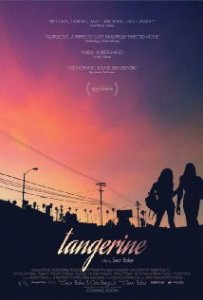
Tangerine PosterIt’s Christmas Eve in a sun-drenched Hollywood. Sin-Dee Rella is a transgender prostitute back out on the block after a month in prison. Her first stop is Donut Time, a divey hangout that’s pure LA. Her best friend and fellow trans-prostitute Alexandra thinks they’re celebrating. Sin-Dee’s pimp boyfriend Chester has been cheating on her while in prison, and not with anyone, but with some “fish”, their clever way of saying that bitch has a vagina.

Except this is news to Sin-Dee, and shit’s about to go down. We’re off to the races now.

This is the set-up of “Tangerine”, a fast-moving, spitfire, gangsta and girl power indie that’s a pure riot. Sean Baker’s film cranks the volume on a soundtrack that’s thug-life hip hop and dubstep and burns through an indie buddy comedy that’s hilarious, outrageous, but also potentially groundbreaking in its portrayal of transgender actors and stars. “Tangerine” is the most queer movie of the year, but also the most fun.

That’s because Sin-Dee (Kitana Kiki Rodriguez) gives no fucks on her quest to find Chester and the girl he’s cheating with, and though Alexandra (Mya Taylor) says she doesn’t want any drama, you know that’s all we’re going to get. Sin-Dee marches out of Donut Time as gunshots ring out on the soundtrack and rave music follows her down the street. Baker turns her into Dirty Harry, marching down Sunset with a vengeance, throwing burns and an increasingly creative vocabulary at anyone who pretends they don’t know where to find Chester (James Ransone) or that fish, whatever her name is. Something with a “D”.

Of course Sin-Dee isn’t the only girl on the block. And Alexandra’s only other real friend is a married cab driver named Razmik (Karren Karagulian). He solicits a prostitute only to be disappointed to learn that she has a pussy. He regularly goes down on Alexandra while passing through a car wash, anything to get away from the drunks and losers who take up space in his cab.

“Tangerine” is really a film about community. When Sin-Dee finally finds Chester back at Donut Time, the whole film turns into a small-scale circus and shit-show. But what has emerged through this entire day is a group of people who know everyone’s names, who occupy the lesser-traveled areas of Tinsel Town, and who have a mutual code and respect for everyone on the block. Even the cops are in on the game, calling Alexandra by name and giving her a pass when a guy tries to stiff her of $40. In a weird way when everyone is yelling and getting themselves thrown out of Donut Time, these people end up feeling closer. Alexandra didn’t want drama, but that’s what she got, and we know these people a little better.

Tangerine1

Baker feels so close to his characters because “Tangerine” has the character of a home movie. Baker shot the entire film on an iPhone, and it looks gorgeous. The camera creates a sun-soaked movie full of vibrancy, it moves quickly and smoothly with the same sense of purpose as Sin-Dee, and it captures wide shots that match Alexandra’s loneliness. The purple, fluorescent hues of “Tangerine’s” horizon would be a shot to die for even with the best camera available.

“Tangerine” quotes a line near its conclusion: “Los Angeles is a beautifully wrapped lie.” Baker has wrapped LA around his finger, and he’s made yet another beautifully definitive movie of life in the city. But with its honesty toward transgender individuals and to this community at large, “Tangerine” is no lie.

3 ½ stars

Mr. Holmes

Ian McKellen and Laura Linney star in Bill Condon’s reimagining of Arthur Conan Doyle’s famous detective.

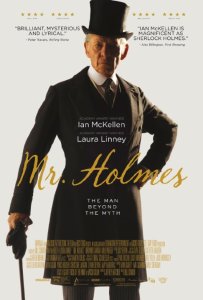
Mr. Holmes PosterAt this point even a revisionist version of Sherlock Holmes has grown stale. The character has become so ubiquitous, with its own resurgence in the last 10 years, that anyone who thinks they’re genuinely putting a new spin on the character is likely trying to pull one over on everyone, and Holmes himself would be the first to call their bluff. The Robert Downey Jr. version of Holmes in the Guy Ritchie films may have been a wacky street tough, but those films might’ve actually veered closest to the original Arthur Conan Doyle creations than anything.
Make no mistake, “Mr. Holmes”, the new film by Bill Condon that tries to demystify Holmes in his old age, is still very much a Sherlock Holmes film. The reason it succeeds, largely due to Ian McKellen’s worn and weary performance, is that Condon’s film actually caters to adults. Only about half of the film is a traditional Holmes caper, but with all of the fantasy and spectacle removed. The remainder is a film of identity, a man near the twilight of his life, past his glory days, grappling with his reality both internally and publically. The mythology Holmes has to contend with only deepens and sweetens this mystery.

In McKellen’s first moments on screen you can immediately sense his age and experience. Holmes is a grump, but he’s highly observant. He arrives at a country home where he tends to bees in his apiary, but in his old age he’s at the will of his housekeeper Mrs. Munro (Laura Linney) and her young son Roger (Milo Parker). Roger is impressed by Holmes’s ability to know where people have been just by looking at them, and while Holmes still has his wit about him, his timing is far slower.

McKellen plays Holmes with a degree of vulnerability, something that’s been rare among his foreboding superhero and “Lord of the Rings” work. There’s a sense that he’s well past his prime. In a diary, a doctor instructs him to make a dot every time he’s forgotten something, and the pages turn into a constellation of connect the dots. And yet he still has an exact count of the number of times his bees have stung him: well over 7,000 times.

Roger has also taken an interest in a story Holmes is writing recounting one of his most famous and final cases. In it, he’s investigating the habits of a wife who seems consumed and hypnotized by the glass harmonica. The story on the movie screen is to Holmes a farce, and yet in writing his own version he can’t recall how it ended differently. All he knows is that it must’ve been a failure, or else it wouldn’t have been his last.

Condon takes us into that story within a story, and McKellen gets an opportunity to shine as a showman, not just a weary old man. This is the classic Holmes we know, in which Holmes puts together clues and deduces accusations in a whirlwind that’s otherwise hidden to the audience, but there’s more gravity to this story. It doesn’t resolve in the way we hope and it provides something of a death sentence to his own state of mind. It reveals him as human in what is perhaps the first time Holmes as a character has been brought to such a relatable level.

“Mr. Holmes” is stately in its visual presentation, a more regal period piece instead of a more stylized affair. And while much of the film is slow and concerned with the calm, pastoral setting of his country home, it finds some sensation and heavy-handed drama in a surprise trip to Hiroshima.

Only Holmes’s story truly carries “Mr. Holmes”, as Condon stumbles in making Mrs. Munro’s side plot challenges with raising her son meaningful to Holmes’s main tension. But Holmes’s revisionist history itself remains one worth investigating.

3 stars

Z for Zachariah

Craig Zobel’s follow-up to ‘Compliance’ is an intimate love story set at the end of the world.

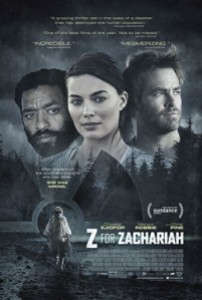
Z_for_Zachariah_posterThe indie drama “Z for Zachariah” is a post-apocalyptic sci-fi in name only. Movies such as this year’s “Ex Machina” or the horror film “The Babadook” have played with genre as their setting to tell what is essentially a contemporary story. The scene and the plot are merely set dressing for a bigger parable.

Craig Zobel’s (Compliance) film however maintains such a tenuous relationship to its post-apocalyptic scenario that it’s a wonder he didn’t do away with it entirely. “Z for Zachariah” follows the survivor of a radiation outbreak living peacefully alone in her country farm and how she comes to care and love another survivor who stumbles across her home.

More so than a sci-fi, “Z for Zachariah” is a marital romance, and eventually a love triangle. It deals with questions of intimacy, faith, commitment, trust, personality and habit. None of the preceding has much to do with the act of surviving a nuclear outbreak, but these themes are contained in well-drawn and acted characters and a tender, theatrical scope.

Ann (Margot Robbie) is a country girl living in her secluded slice of the world, a valley that has remained untainted by radiation and the effects that seem to have wiped out humanity. John (Chiwetel Ejiofor) is another resourceful survivor who has made his way to the valley, only to fall sick and in need of Ann’s help for survival.

In them we see how tragedy, need and circumstance has brought out their core beliefs. It’s a battle of faith versus science, as Ann falls back on her Christian upbringing to help her sustain, while John is analytical and logical. He devises a plan to bring electricity back to her farm, but only at the expense of tearing down Ann’s cherished chapel.

They grow close and nearly intimate but withhold their temptations. These things need time, and they’ve got nothing but time, John explains. That changes when the drifter-type Caleb (Chris Pine) arrives on their doorstep. He’s a slick country boy with an equal helping of faith that John lacks, and his mere presence consistently makes him an untrustworthy figure driving a stake between Ann and John.

Ejiofor quite often steals the show, paring dialogue down to its quietest and simplest. He just seems profound and shrouded in feeling no matter when he’s speaking, including a bombshell about his past before arriving on the farm. But he even gets the chance to stretch himself, playing broad when initially exposed to radiation and comic when he gets drunk and learns that Ann, “even at the end of the world, ain’t gonna drink no cherry soda.”

Pine too has proven with this film he can act, casting sly glares and piercing glances that keep his character’s intentions ambiguous. As for Robbie, she’s a budding star who earns her keep as a tough, capable farm owner despite how low-key and coy she remains. Ann unfortunately becomes “the woman” and has far less to do once Caleb arrives and turns the romance into a love triangle.

Together the three of them bring unexpected depth to a story that’s as worn and traveled as the man at the end of the world. And yet Zobel can do little more than make his film a travelogue. Shot in New Zealand but done up to look like the American South, “Z for Zachariah” is less an atmospheric story than its plot suggests. The film is intimate enough that it could sub on stage, but it loses some of its cinematic qualities. in the process

Near the film’s ambiguous ending, Caleb expresses a desire to travel further south in search of what word has is a community of survivors, despite the refuge he’s found. Take “Z for Zachariah” out of the apocalypse and you’d have the same movie. That core story is something quaint and special, but there must be something more out there.

3 stars

The Babadook

Jennifer Kent’s debut film is a psychological horror film more than a literal one, but is as scary as any.

the-babadook-posterThe monster inside us is often the scariest of all. What are we capable of if pushed to the edge? What demons are we harboring? And can we ever escape?

Jennifer Kent’s “The Babadook” is one of the best horror movies in a decade. The monster at its center is a personal demon, not quite a literal one. The thrills and scares come early and often, but the monster itself remains dormant beneath a veil of family drama and psychological turmoil.

Amelia (Essie Davis) is the single-mother to her 7-year-old son Samuel (Noah Wiseman), a precocious young boy but one who finds it hard to be around other children. He doesn’t see monsters, but he believes in them more than the usual child, to the point that he creates makeshift weapons to stop would-be intruders and takes up the defensive immediately for those who would insult or harm his mother. It gets him into trouble, both at school and with his aunt, who no longer wants to be around Samuel and his habits.

Amelia is suffering through a job at an old folks home and is struggling to find a new school for Samuel once his antics get him dismissed. At the same time, she has a recurring dream of her husband’s death in a car crash, who died on the day Samuel was born no less.

All these problems begin to burrow deeper under Amelia’s skin after Samuel finds a sinister looking children’s book called “The Babadook”. There’s a long history of horror movies summoning monsters by reading the pages of an old, ancient book, poem, or diary, but Kent has a visual style that doesn’t linger on the rhyming words and mantras so many other films default to.

Kent’s style is aural editing, with each cut punctuated by each noise, creak, or flourish that seem to resound inside Amelia’s head like a migraine. “The Babadook” is gray and flush of color, but as Amelia’s stress grows more weary, Kent finds a way to sap it of additional light, even going as far as to bend the proportions of their English cottage to surreal angles. There’s a scene at a birthday party in which Kent frames Amelia opposite five leering housewives in a domineering arc. Who are the real monsters and villains of this story?

Perhaps most fascinating is how Kent allows us to get inside Amelia’s head. There are moments of relief for her, like when she takes off work and finds a moment of solace while eating an ice cream cone. The shot is luminous and a dreamy moment of escapism, all before we come crashing down to reality. Kent even toys with our sense of reality, particularly in a scene where Amelia scrambles to patch a hole filled with cockroaches, only to find when guests arrive that the hole was never there.

How do fear, guilt, and frustration with the many nuisances and challenges in our lives begin to mount? “The Babadook” is terrifying for sure, but it’s a drama of depression first, and how when all these stresses come together in a perfect storm, it can be self-destructive.

Essie Davis above all leads Amelia’s mental breakdown and transformation. It’s a jaw-dropping performance that escalates to enormous volumes in the film’s climax. Davis becomes so dangerous and so unpredictable so organically that we hardly see it coming. Her decline and her anger seem so natural, despite how quickly monstrous her actions become, and it’s truly scary.

The film’s ending is perhaps the most polarizing aspect, but it’s a perfect one. “You’ll never get rid of The Babadook”, the book taunts. For Amelia, she’s coping with the grief of losing her husband, even seven years removed from the accident. That pain never goes away, but you have to feed those demons to tame them, and they can overcome you when things get bad.

Most dramas are hardly this perceptive of human nature, let alone indie horror movies. “The Babadook” is so unsettling because it’s so familiar, and it spawns a fear you can’t erase.

4 stars

Mission: Impossible – Rogue Nation

The fifth in the MI franchise, Christopher McQuarrie and Tom Cruise have elevated the series to James Bond status

MI5PosterDaniel Craig and the new James Bond left a campy-sized hole in the hearts of many an action movie lover. The films became so polished, so good and even so plausible that while no one was clamoring for a throwback to Pierce Brosnan ice palaces and invisible cars, there’s a sense that spy stories could be a little less serious.
Enter “Mission: Impossible”, which five entries in has shed its TV adaptation roots and finally taken Bond’s place on the franchise throne. Previously the “MI” series has been a malleable Tom Cruise vehicle: a Hitchcockian thriller in the hands of genre stylist Brian De Palma, a visual showcase in the hands of John Woo or a dense conspiracy caper in the hands of J.J. Abrams. The fourth film, “Ghost Protocol”, was so delightfully cartoonish (in the hands of none other than Pixar’s Brad Bird making his live-action debut), that even dangling Tom Cruise off the tallest building in the world was not the most outrageous part.

So what is ironically fresh about the latest and fifth entry, “Mission: Impossible – Rogue Nation”, is that Director Christopher McQuarrie isn’t trying to reinvent the wheel. The film has not taken on yet another new life in the hands of a new director but has found a comfortable groove that combines the best of all four previous films.

The most notable trait of course must be Tom Cruise, who continues to impress and prove why he’s a bankable star despite never once setting foot in superhero spandex or body armor. In purely Bond fashion, Cruise opens “Rogue Nation” with an incredible set piece detached from the plot of the main film. Cruise’s Ethan Hunt leaps aboard a taxiing plane and hangs on for dear life even after the plane takes off.

And that’s Cruise’s career in a nutshell: trying so hard and still able to hold tight against all odds even as every young teen star takes flight.

Here Cruise’s Ethan Hunt undergoes the Mel Gibson in “Lethal Weapon” treatment, being suspended from the ceiling and beaten and tortured, only to acrobatically crack some skulls and escape. He’s on the run after coming across an agent he believes to be the head of The Syndicate, Solomon Lane (Sean Harris). The Syndicate is a shadow organization made to destroy the IMF, and which Hunt believes was behind several global accidents he and the IMF were been unable to avert.

Lane’s frail, crippled tone behind glasses, a German accent and a short haircut make him sound like a man struck by lightning as a child. He’s a convincing ghost, and one of the franchise’s more memorable villains, if still behind Philip Seymour Hoffman from “MI:3”.

But the IMF is also facing a challenge from the CIA and their operation head, played by Alec Baldwin. The CIA is in denial that any Syndicate even exists, and the IMF’s biggest lead is a double agent named Ilsa (Rebecca Ferguson) who they first encounter attempting to murder a German chancellor.

It’s enough spy mumbo jumbo to keep the wheels moving and not too much to overwhelm the story in Macguffins and pseudo-science jargon. And the help of returning cast Simon Pegg and Ving Rhames continue to keep things light and tongue-in-cheek.

Because part of what makes “Rogue Nation” so refreshing, and for that matter all the “Mission: Impossible” movies, is how outlandish and oversized the film’s various set pieces can become, and yet are never once CGI maelstroms. One scene takes place in the backdrop of an opera in Vienna, and to say it’s magnificent, musically edited, and operatic is an understatement. Then there’s an underwater scene where Cruise has to hold his breath for three minutes while avoiding rotating gears and security blocks. It’s preposterous and near impossible to describe or rationalize, but in 2015 it’s more memorable than any horde of disposable robots.

These are traditional action movies after all, but when Bourne has gone gritty, the “Fast and Furious” movies have grown into their own superhero films, and John Wick has gone downright minimal, it’s nice to see that Ethan Hunt’s missions still look impossible.

3 ½ stars

The End of the Tour

Jason Segel, alongside Jesse Eisenberg, shines as ‘Infinite Jest’ author David Foster Wallace in James Ponsoldt’s latest.

In Woody Allen’s “Midnight in Paris,” the young writer Gil asks Ernest Hemingway if he would offer an opinion on the book he’s writing. “My opinion is I’ll hate it. If it’s bad, I’ll hate it because I hate bad writing, and if it’s good, I’ll be envious and hate it all the more. You don’t want the opinion of another writer. Writers are competitive.” It’s not a real Hemingway quote, but it feels like one, and it gets at the dilemma of another great writer, David Foster Wallace.

In “The End of the Tour”, Director James Ponsoldt (“Smashed”, “The Spectacular Now”) documents the last few days of Wallace’s book tour for his American literary classic “Infinite Jest”. Rolling Stone reporter David Lipsky planned to spend a few days with Wallace and pick his brain, but the two are each insecure and in awe of the other. Their competition and their conversation gets the better of them, and in their pursuit to tell a good story, they realize they’ve created more conflict than this story deserves.

Ponsoldt’s film might be the best movie about writing since “Almost Famous”, and it avoids the trap of actually being forced to sit through the tedious visuals of writers writing. Jason Segel is wonderful as Wallace, and “The End of the Tour” recognizes that the best writing isn’t always about the story itself, but the details.

Ponsoldt opens the film with Lipsky (Jesse Eisenberg) learning of Wallace’s suicide in 2008, acknowledging that there’s a hint of grief and pain hanging over Wallace’s character and why Lipsky feels in part responsible. It then flashes back to 1996, shortly after “Infinite Jest” was first released. Lipsky picks up Wallace’s book, and like the writer he is proclaims, “Shit”, at just how good it is.

Lipsky himself is a struggling novelist in addition to his work as a journalist, and he feebly offers Wallace a copy of his own published work, expecting to be humbled by the opinion of a literary genius. Lipsky is so in awe and generally polite he praises Wallace’s winter view in Southern Illinois. “Thanks, I can’t take credit for it,” Wallace says thanks to Segel’s wonderfully understated and amicable tone. But while they talk of the fear of the rise of technology, of writing and of issues of fame, Lipsky is shocked at how easily they’re able to shoot the breeze. Together they eat baloney sandwiches after discussing existentialism. They confess their love for Alanis Morissette. Wallace tells an embarrassing story about being a pool towel boy for a writer he just sat on a panel discussion with, before Lipsky flips a switch and asks about Wallace’s suicide attempt. Their conversation is pretty and profound in a sloppy, ultimately human way.

What’s most revealing and honest about the story however is that there isn’t really much of a story here in the first place. Lipsky thinks Wallace is playing down his brilliance in a way that’s not only guarded and false, but also condescending. Lipsky’s editor even urges him to push Wallace for details about his past suicide attempt and rumored drug addiction.

The reality however, something Ponsoldt captures in his plain, intimate cinematography and Segel nails in his quietly deep, yet charming and relatable performance, is that he’s not faking it. There’s not a genius here but a person. When he wears a bandana, he’s not doing it as a “trademark” but because it’s a “thing” he likes. There’s no hidden mastery behind this guy who teaches English in Southern Illinois, and that shouldn’t change his achievement. We want the person on screen or on the page to be larger than life, and Ponsoldt and Segel help bring it down to size.

With all three of his previous films, Ponsoldt has found the modesty in his characters to flesh out their humanity. With “The End of the Tour”, he’s made a film about such modest proportions and demonstrated its value.

3 ½ stars

The Overnight

Patrick Brice’s ensemble comedy is a movie truly for adults, with Adam Scott, Taylor Schilling and Jason Schwartzman.

TheOvernightPosterMaking friends as an adult is hard. This much we know. Sex can be complicated, and awkward. This much we all know very well. But when posed with the challenge of making friends and breaking out of your shell despite all the misgivings of being socially or sexually awkward, it can be extremely challenging.

“The Overnight” pushes those adult challenges to the limit in a film that gradually becomes more surreal, stylish and engrossing. It’s a small ensemble comedy with some surprising twists that does some impressive gymnastics and social maneuvering to keep from going crazy and ending things on the spot. It asks the question, “Is being curious as an adult a bad thing?” And never does Patrick Brice’s film, despite how outrageous and strange it becomes, cross that line that would make you think otherwise.

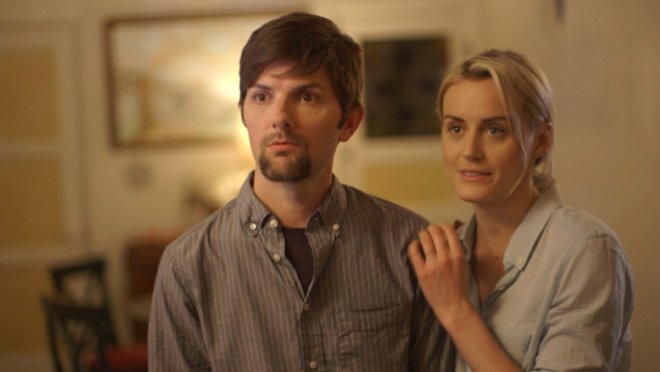
Part of what makes “The Overnight” work so well is that it really is an “adult comedy”. Unlike the Seth Rogen movies of the world, the characters of “The Overnight” really are adults, and not just oversized man-children. Alex and Emily (Adam Scott and Taylor Schilling) are parents of the pre-school aged RJ but are also new to the Los Angeles neighborhood. At a party for a friend of RJ’s, they hit it off with Kurt (Jason Schwartzman). Kurt seduces them effortlessly with his sophistication and cultured charm, but Schwartzman’s performance, an actor who began his career in “Rushmore” as someone mature and adult beyond his age, is balanced enough that Kurt seems effete without ever appearing insincere.

Kurt invites them to a dinner party with his wife Charlotte (Judith Godreche) and open Alex and Emily up to a whole realm of adult “experimenting” as soon as the kids are in bed. What transpires is a mix of uncomfortable humor, free-spirited celebration and eventually, drunken, delirious tripping out.

Brice navigates these sudden twists in tone with the same hilariously awkward thud that Alex and Emily might be feeling, namely because Kurt and Charlotte are so confidently cultured and European. Their home is a modern fortress, and Kurt regales Alex with his work desalinizing water from feces, doing abstract artwork of people’s buttholes, and putting their children to sleep with synth-driven lullabies.

TheOvernight

Alex meanwhile is just trying to stay afloat, desperately treading water to make it seem like he and his wife are smarter than they are. Brice opens the film with their own marital struggles, having sex at the crack of dawn in a race to beat their son awake, and each furiously finishing on their own because of their inability to satisfy the other sexually. Their frustrations, inadequacies and embarrassment at the party is so relatable, in part because of Adam Scott’s clueless demeanor as he fast talks his way out of trouble, and Taylor Schilling’s over-enthusiastic smiles and hand gestures that show how desperately they want to fit in.

The characters are constantly pushing the limits of finding the threshold, the point when things simply get too weird and they force themselves to leave. At that point, the movie would be over, and while the characters constantly push the boundaries, the movie never gets there. Thankfully, it’s Alex and Emily who throw their hands up before we do.

“The Overnight” probes at challenging situation comedy and the difficulties of friendship, marriage, parenting and new experiences with equal parts grace and awkwardness. It’s never uproariously funny or a life changing few hours (actually, the film clocks in at a brief 79 minutes). But just as Alex and Emily will remember what happened here for a long time to come, so will we.

3 stars

The Stanford Prison Experiment

The Stanford Prison Experiment is a fictional reimagining of real life events that became Psychology 101.

StanfordPrisonExperimentPosterThe Stanford Prison Experiment is Psychology 101. Introductory textbooks on the subject all make note of the events that took place at Stanford University in August of 1971, in which 18 college-aged participants and students simulated a prison environment as part of a psychological study by Philip Zimbardo. Half took shifts as ruthless, abusive guards, and the other half were punished, degraded, humiliated and malnourished as a part of their imprisonment. After just six days of an allotted two weeks, the results predictably did not end well. Students today look back on it as an example of a study gone horribly, ethically wrong, but also as an example of behavioral psychology.

The film adaptation of this, also titled “The Stanford Prison Experiment” and directed by Kyle Patrick Alvarez, should also feel like essential psychology. The film makes abundantly clear in a string of darkly tense, even twistedly funny set pieces, just what happened here and how much a situation like this could affect these individual’s minds. What’s more, Alvarez leaves morality out of the equation. There’s notable ambiguity as to whether such an experiment should’ve ever been conducted, or if it actually produced real academic results and lessons on psychology.

But Alvarez misses an opportunity. “The Stanford Prison Experiment” is a horror story, a terrifically acted and fascinatingly lensed experiment of its own. But like the prison experiment itself, the horrors Alvarez subjects us to are mostly one-dimensional.

In the film, Zimbardo (Billy Crudup) shares the goal that the experiment is designed to test how an institution affects an individual’s behavior. With that broad of a thesis in mind, any experiment could be a success, and the Stanford Prison Experiment would qualify as a rousing one. But it’s hard to know what, if any, academic value any of this actually had.

All Alvarez makes clear is that it has an impact, and that when pressed and put under certain institutional circumstances, you begin to play the part. Prisoner 8612 (Ezra Miller) is the first to break. He’s sarcastic and non-conformist, and leads a successful revolt on the second day to barricade the doors to their cells so the guards can’t get in. But when he’s locked in the hole and has his rebellion ignored and subdued, he quickly begins to believe his imprisonment is real. On the other side of the coin, the prisoners lovingly dub one guard John Wayne (Michael Angarano) for how he dons a Strother Martin in “Cool Hand Luke” impression whenever he disappears behind those one-way aviator sunglasses.

Alvarez’s film is a series of these grim prison set pieces. One of the film’s first and best involves John Wayne making the prisoners recite their numbers in a role call. The camera tracks swiftly down the narrow hallway as each prisoner rattles off their rank, and Alvarez finds an awful lot of room for motion and leering framing without sacrificing the claustrophobic space of the actual set.

These re-imagined moments of history, all of them highly accurate to the available footage seen online, are so calculated and choreographed that the deliberate pacing calls attention to the abuse of the task-master guards. They’re arduous, torturous, talkative set pieces in which time evaporates and the scene becomes truly, psychologically draining.

That illusion disappears however when we step into Zimbardo’s real world. These scenes watching Zimbardo and his fellow colleagues observe the prisoners are far more procedural without feeling notably academic or insightful in terms of the film’s themes. Zimbardo begins to look less deranged and consumed and more clueless, as everyone ignores obvious signs of abuse and madness to the prisoners as though they were just flukes.

Alvarez isn’t interested in making a morality tale condemning Zimbardo or the students involved. This film isn’t a question of whether this study should or shouldn’t have happened. It doesn’t even contain the prison reform commentary that would eventually become part of Zimbardo’s later career. But if you’re not going to pose those questions about the academic value of such a study, why even include those scenes at all?

I imagine a Stanford Prison Experiment movie in which the Zimbardo character is completely absent, in which students get instructions from faceless figures, and the behind the scenes pulling of strings is as hidden to us as it is to the tormented and confused characters.

Alvarez really does manage to build a sense of terror and psychological dread. And the film is made up of an incredible who’s who of young actors, all of them standing out in individual set pieces, from Miller and Angarano to Tye Sheridan, Thomas Mann, Keir Gilchrist, Johnny Simmons, Nicholas Bruan, James Frecheville, Chris Sheffield and more.

But in just offering a historical document, Alvarez misses a chance to conduct his own psychological experience on his audience. “The Stanford Prison Experiment” is a powerful film, but perhaps not affecting.

3 stars