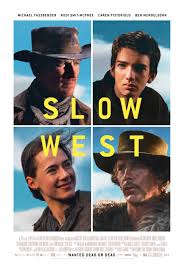
 Lying on the ground in the Old West, a naïve boy and a grizzled bounty hunter look up to the moon and constellations in the night sky. The boy cocks his fingers into a gun and shoots holes in the heavens, and the bounty hunter says that when we finally get to the moon, the first thing we’re likely to do is kill all the natives that live there. Even space is a reflection of their bleak reality.
John Maclean’s “Slow West” is a Western as a fairy tale, an often unusual and quirky independent film with more than a few stylized, surprising moments like those above that buck the conventions of the genre. “Slow West” starts as a coming of age story of overcoming naïveté and insecurities, and it at least seems less interested in the violent, bloody resolution where it inevitably ends up. Maclean’s film tries to be economical and subtle in its storytelling but often feels light on strong narrative if not outright contrived.
Jay Cavendish (Kodi Smit-McPhee) is a young Scottish man come to America to reunite with the love of his life, Rose Ross (Caren Pistorius). Lost in the wilderness and in danger, he teams up with a bounty hunter named Silas Selleck (Michael Fassbender) to get him to his destination in one piece. Except Silas is using Jay to reach Rose first, who has a hefty Dead or Alive bounty on her head, a fact unbeknownst to Jay. Jay is also oblivious to how little Rose actually cares for him. We see in a flashback in Scotland that she thinks of him as “like the little brother I never had” rather than Jay’s true love. When Silas comes to the realization, “You haven’t bedded her yet,” it’s clear just how fruitless Jay’s journey is.
Maclean (who also wrote the screenplay) fills in the gaps of Jay and Silas’s motivation through some clunky voice-over narration. It’d rather tell us that Silas is the ruthless, loner type than actually show us, and surprisingly rarely does Fassbender get to actually perform the stunts and acts of gunslinger heroics that would prove to us just how dangerous he’s supposed to be. Silas even gets sidelined during the film’s unnecessarily bloody ending and even cheesier coda, and his change of heart to protect Jay and his interests comes from nowhere.
It’s the more modest, artistic moments that help “Slow West” stand out as a potential indie darling. In one scene, Jay separates from Silas and happens across an amicable German writer making camp in the middle of an open, desolate swath of desert. The still image cinematography has some otherworldly beauty, and Maclean reaches for more profound ideas of “dreams and toil” that defined the Old West philosophy. In another, Silas and Jay admire a skeleton of a man crushed by a tree he was chopping down. “Natural selection,” Silas crows.
“Slow West” is weirdly stylish and thoughtful in these isolated moments, but they hardly feel baked into a complete whole. It’s a fairy tale without much of an ending.
2 ½ stars
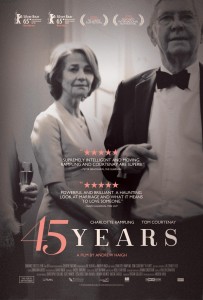 “They found her body…I know I told you about my Katia.” That little word “my” effectively seals the fate of the marriage of Kate and Geoff Mercer in Andrew Haigh’s film “45 Years.”
 In “The Witch,” the latest in a hot streak of indie horror films, the devil is only half of this family’s problems.
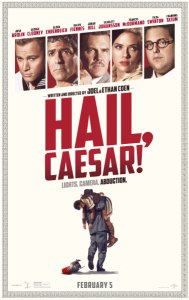 The Coen brothers’ “Hail, Caesar!” acts as a sizzle reel for all the classic Hollywood film genres the pair could’ve honored and lampooned throughout their career but never got the chance. It shows how the Coens might do a sword and sandal epic, a lush costume melodrama or even a Gene Kelly musical. But “Hail, Caesar!” is a movie about the future, a post-modern mish-mash of genres and styles that hints at where history will take cinema as much as it is a throwback. The Coens are having a lot of goofy fun but still manage a surreal, captivating art picture on par with many of their classics.
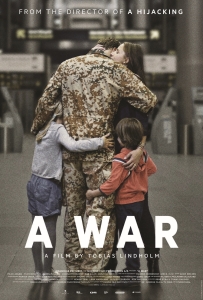 “A War,” the Danish film nominated for this year’s Best Foreign Language Oscar, is the rare war film to consider a soldier’s practical war as well as a moral one. It’s not just about coping with life after war, but about how a soldier faces hard decisions and consequences upon returning home.
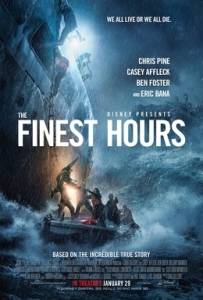 The members of the Coast Guard don’t get the credit that cops, firefighters or soldiers do for saving lives. “The Finest Hours,” Disney’s telling of an historic rescue mission, is full of heroics but also people just doing their job. It’s a sentimental, old-fashioned thriller but is also endearingly modest.
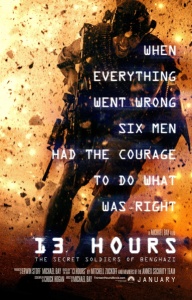 Michael Bay’s “13 Hours: The Secret Soldiers of Benghazi” is the perfect storm of stereotypes, fear mongering and questionable politics in an overly stylized, testosterone-fueled, action thrill ride. Give Bay a little credit: hand him a real world war story that has become the subject of heated conspiracy theories and he’ll still find a way to pack it with explosions, unseemly blue lens flares and canted angles designed to make his beefed up soldiers look like Transformers.
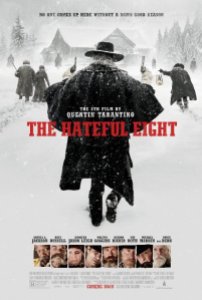 Quentin Tarantino, a truly favorite director of mine, can be called a lot of unsavory adjectives, but I never thought “boring” could be one of them.
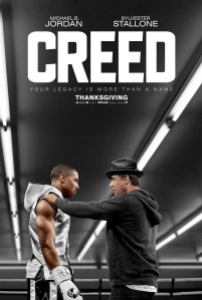 “Rocky” is one of the finest examples of Americana ever put onto film, and “Raging Bull” is among the absolute best movies of all time. But outside of those two obvious choices, the most memorable boxing movies are the ones that go beyond just being a boxing movie. “The Fighter” plays with genre conventions by invoking family dynamics and a drug addicted brother who is more interesting than the protagonist. “Million Dollar Baby’s” final fight isn’t in a ring at all.
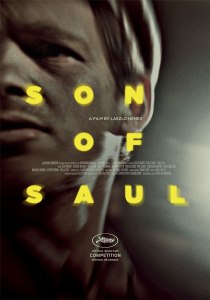 The foreign drama “Son of Saul” finds a way to give us yet another new look at the Holocaust, but its innovation is in finding the imminent danger in every moment of these prisoners’ lives. Director Laszlo Nemes shuttles us into the back of the head of Saul Auslander (Geza Rohrig) and shows us things only in his immediate field of vision. There’s a palpable, hushed tension coursing through every scene, and yet it remains impossible to foresee the threat even seconds ahead.